How to think about AI productivity in your org
Here’s the thing. Lately, I’ve been having the same conversation on loop with colleagues and friends who run businesses. I see them looking at these massive productivity gains happening around them in the engineering departments using AI, and then they immediately try to apply those exact same expectations—those same velocity metrics—to everyone else. Marketing, Sales, Finance, Consulting... you name it.
I can’t help but think how incredibly flawed this is right now.
Let’s look at coding. It’s a common trap to look at AI coding tools and think, “Great, we’ve solved knowledge work.” We haven’t. What we have actually done is applied AI to a domain that possesses the most mature, automated verification ecosystem on the planet.
You cannot apply the speed of an inherently verifiable task to domains that are fundamentally unstructured. If you want to anchor your AI strategy in reality, not hype, you need to stop looking at engineering velocity and start looking at two specific variables: Verification-Harness Maturity and Context Profile.
Here is the model I use to anchor reality.
Dimension 1: Verification-Harness Maturity
Initially, I thought about this as “Blast Radius”—what happens when an agent makes a wrong decision? But that’s the wrong primitive. What actually keeps high-velocity AI coding safe isn’t that errors are cheap. It’s that we have compilers, unit tests, and CI/CD pipelines to catch them.
When your AI agent hallucinates a variable or writes a silent logic error, an automated harness flags it before it hits production. You fix it and move on. Velocity stays high because the cost of verifying the work is near zero.
Now apply that same lens to other departments:
Marketing (High Verification): If an agent generates a campaign, you don’t have a compiler, but the verification is visual and instant. You glance at the collateral. Is the hex code right? Are there typos? Yes/No. The verification friction is incredibly low, so tactical marketing sees massive AI productivity gains.
Finance (Zero Verification): If a finance team uses an agent and it hallucinates a “one zero error” on a ledger, things fall apart fast. There is no automated unit test for a financial audit. That one zero skews reporting and leads to a disastrous capital allocation decision. Without a verification harness, you are flying blind.
Dimension 2: The Two Types of Context
The second dimension is context, but we need to split this into two very different categories. I like to think of an organization as a series of concentric circles. The periphery is low-context, and the core is high-context. But what kind of context?
Solvable Context (Retrieval): This is the tribal knowledge, the historical logs, the documentation. It’s hard to get, but it is a solvable data-engineering problem. You can index codebases, connect MCP servers to Jira or Salesforce, and pipe that context into the agent.
Irreducible Context (Judgment): As you move to the core of an organization—strategy, consulting, M&A—the context changes. It becomes about internal politics, stakeholder emotion, cultural zeitgeist, and trust. You cannot pipe the emotional state of a client into an AI agent. This context is irreducible.
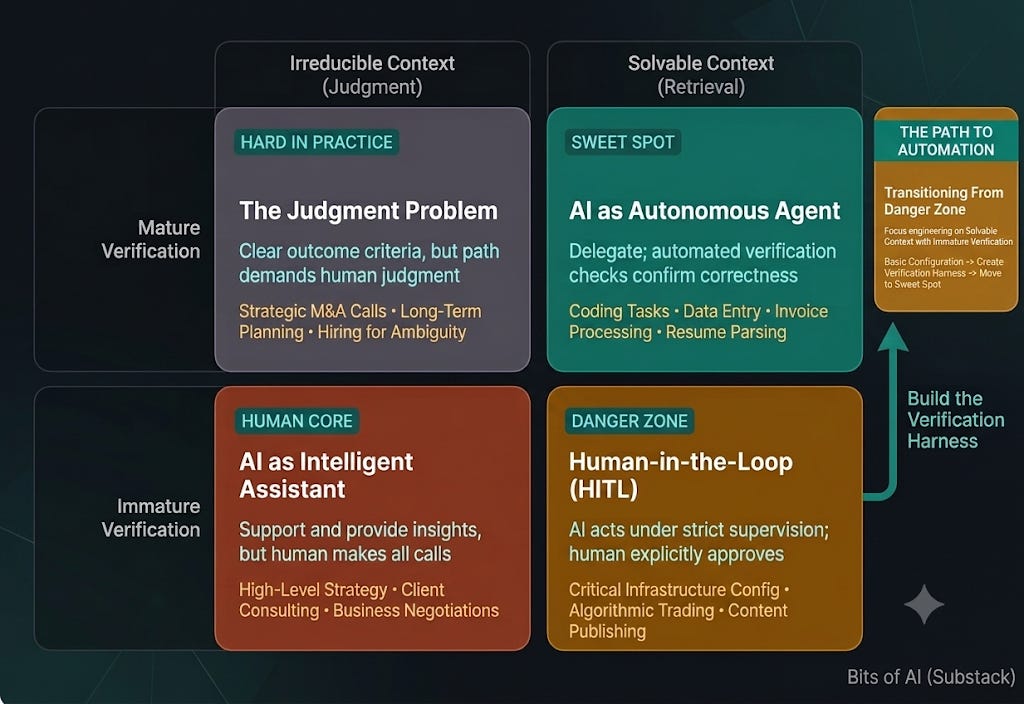
The AI Viability Matrix (The Static View)
If you map these two dimensions, you get a clear view of where AI works today.
The Sweet Spot (Mature Verification + Solvable Context): Tactical coding, resume parsing, generating social media assets. The data is available, and you can instantly verify the output. Automate this ruthlessly.
The Danger Zone (Immature Verification + Solvable Context): Basic infrastructure configuration or automated trading. You can feed the agent the exact server logs it needs, but there is no safe environment to test the output. One wrong configuration takes down the network. This requires strict human-in-the-loop guardrails.
The Human Core (Immature Verification + Irreducible Context): Consulting, strategy, and complex finance. The currency here is trust. If you “wipe consult” your way through a client problem and an AI hallucinates a market trend, that relationship is dead. You cannot automate the verification, and you cannot retrieve the context. AI is an assistant here, never an agent.
The Builder’s Reality: Engineering the Curve
Now, here is the secret: this matrix isn’t static. It’s a cost curve.
The core high-impact work tends to cluster in the “Human Core” because it lacks verification and relies on judgment. The goal of an AI team isn’t just to map tasks into these buckets and leave them there. The goal of a true AI builder is to drag tasks out of the Danger Zone and into the Sweet Spot.
How? By engineering the environment.
You don’t just deploy an agent to do financial reporting; you spend six months building a deterministic, automated QA pipeline for your ledgers first. You don’t just ask an agent to do operations; you build the telemetry and logging systems that turn “tribal knowledge” into “solvable retrieval.”
Expecting uniform productivity gains out of the box is a fantasy. The departments seeing 10x gains aren’t just using better AI—they are operating in environments built to handle automation safely. If you want those gains in other departments, you have to build the harness first.
Here is an AI generated image to represent the model.